Carpenter ants are the large black ants you see in Toronto homes in spring, and unlike the small kitchen ants, these nest inside your wood. They do not eat it. They chew galleries through damp or damaged framing to make room for the colony, and left alone they weaken it. The first job is always to tell them apart from termites, because the two are confused constantly and the response is different. Most carpenter ant jobs run $250 to $500, because the work is finding the nest, not spraying a trail. If you are seeing big black ants indoors and small piles of what looks like sawdust, that is a carpenter ant sign, and it usually means moisture somewhere in the structure.
Carpenter ant or termite? How to tell them apart
This is the first question, and it matters, because the treatments and the stakes are different. The good news for Toronto: termites exist in parts of the GTA but are far less common than carpenter ants, so the big black insect you are looking at is almost always an ant.
Here is how they differ if you can get a close look:
- Waist. Carpenter ants have a pinched, narrow waist between thorax and abdomen. Termites have a straight, thick body with no waist.
- Antennae. Ant antennae are bent, like an elbow. Termite antennae are straight and look like a string of tiny beads.
- Wings (on the flying ones). Both swarm, but a carpenter ant swarmer has two pairs of wings of different lengths, front pair longer. A termite's four wings are all the same length.
- What they do to wood. Carpenter ants excavate clean, smooth galleries and push the debris out. Termites eat the wood and pack their tunnels with mud. Carpenter ant galleries look sanded; termite damage looks dirty.
Carpenter ants do not eat wood. They excavate it to nest, and the tell is the sawdust they push out, called frass, piling up below the hidden gallery. If you are finding a small cone of coarse sawdust with bits of insect in it, that is frass, and it points almost straight at the nest above it.
Health Canada's Pest Management Regulatory Agency registers the products used for both, and both are worked by a licensed technician, but confirming which insect you have decides the whole plan. If it turns out to be small kitchen ants instead, the general ant control page covers those.
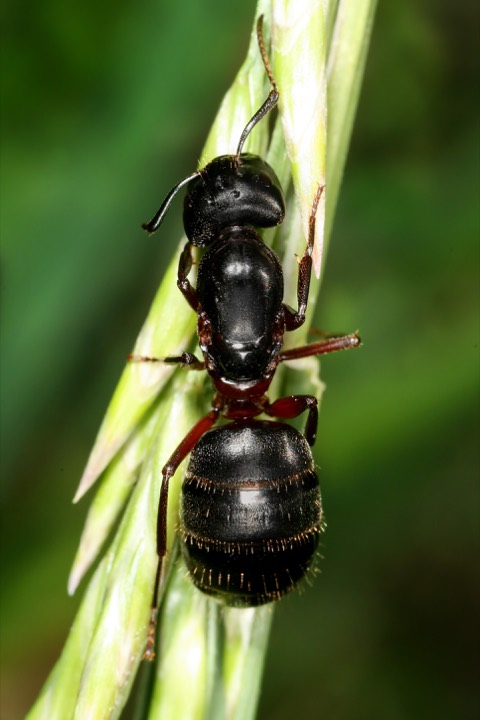

The signs it is carpenter ants
- Large black ants indoors, often a quarter to half an inch long, especially in spring and at night when they forage.
- Frass: small piles of coarse sawdust, sometimes mixed with insect parts and dead ants, under baseboards, in basements, below window frames or in the garage.
- A faint rustling or crackling inside a wall or ceiling void when the house is quiet, the sound of a large colony working the wood.
- Swarmers in May or June: winged carpenter ants gathering at a window are a strong sign of a mature nest inside the structure, not just foragers passing through.
- Ants concentrated around moisture: a leaky roof, a bad window seal, the wood around a bathtub, a damp basement sill. That is where they nest first.
Moisture is the root cause, always
Carpenter ants do not attack sound, dry wood by choice. They move into wood that is already soft: damp, previously water-damaged, or starting to rot. In Toronto that means the usual suspects, a roof leak that has wet the attic sheathing, a window that has let water into the framing, a chronically damp basement sill, a deck ledger that stays wet, wood in contact with soil. Find the moisture and you have usually found the nest, or at least the reason it is there.
Treating carpenter ants without fixing the moisture is a temporary fix. Clear the colony, leave the leak, and a new colony finds the same soft wood next season. Part of the real job is telling you what needs to dry out or be repaired.
How we actually clear carpenter ants
The difference between a lasting fix and a repeat call is whether the technician finds the nest. Spraying the trail kills foragers and does nothing to the colony in the wall.
- Inspection (free). We follow the trails, look for frass, sound out the wood, and locate the moisture. Carpenter ants often keep a main nest outdoors, in a stump, woodpile, or fence post, and satellite nests inside the home. We trace both.
- Find and treat the nest. Once the nest or gallery is located, we treat it directly, and we bait or treat the trails the workers use between the outdoor parent nest and the indoor satellite, so the whole colony is hit, not just the part you saw.
- Address the source. We tell you the moisture problem feeding them: the leak, the rot, the wood-to-soil contact. Fixing that is what keeps the next colony out.
- Follow-up. We return to confirm activity has stopped and the frass is not building back up.
What carpenter ant control costs in Toronto
A carpenter ant job in Toronto runs $250 to $500, higher than general ants because the value is in locating a hidden nest and treating the structure, not spraying a counter. The range depends on how accessible the nest is, whether there are satellite nests, and how much structure is involved.
| Job | Typical Toronto range |
|---|---|
| Single accessible nest, standard treatment | $250 to $350 |
| Multiple satellite nests / larger home | $350 to $500 |
| Extensive structural involvement | $500+, quoted after inspection |
| Follow-up visit (included in most jobs) | usually no extra charge |
The moisture repair (roofer, carpenter, waterproofing) is separate and not our work, but we will tell you plainly what needs doing. Every pest and its price is on the full cost page.
Do you need a pro, or can you do it yourself?
Carpenter ants are one of the pests where do-it-yourself rarely works, because the whole problem is the nest you cannot see. A store bait might thin the foragers, but it will not find the gallery in the wall or the parent nest in the yard, and it does nothing about the moisture that invited them. If you are seeing big black ants indoors regularly, finding frass, or hearing anything in the walls, that is a call. Our honest do-I-need-an-exterminator guide covers where the line sits.
Anyone can kill the ants on your counter. The job worth paying for is finding the nest and telling you why it was there.
Common questions
Are carpenter ants as bad as termites?
They are slower and less destructive than termites, but a large, established colony left for years can weaken framing, and they are far more common in Toronto than termites. The difference is time: termites can do serious damage fast, carpenter ants do it gradually, and both need dealing with.
Do carpenter ants eat wood?
No. They chew galleries through wood to nest and push the debris out as frass, but they do not consume it for food. They forage for the same sugars and proteins as other ants. That is why baiting works on them.
Why do I only see them at night?
Carpenter ants are most active foraging after dark, especially in warm weather. Seeing a line of large black ants in the evening, or on a kitchen counter at night, is typical and is often the first clear sign of a nest.
What do the winged ones mean?
Winged carpenter ants, or swarmers, appear in May and June when a mature colony sends out reproductives. Finding them inside, especially at windows, usually means the nest is inside your structure, not outdoors, and it is a strong reason to have it inspected.
How do I stop them coming back?
Fix the moisture. Repair leaks, improve drainage, keep firewood and mulch off the foundation, trim branches touching the roof, and replace any wood that stays damp. Carpenter ants need soft, wet wood, so a dry structure is the real prevention.
Do I need to leave during treatment?
No. Carpenter ant treatment does not require you to leave the home. If we apply a product, we tell you any area to keep clear and for how long, per the label directions.
Does the guarantee cover carpenter ants?
Yes. If carpenter ants are still active within two months of the treatment, we come back once at no charge.
Reviewed August 2026.
Prefer to talk? Call
(365) 217-5987Tell us the pest and your neighbourhood and we give you a price range on the spot. The inspection is free, and there is no charge to ask.
- Published price ranges, no "call for a quote"
- Free inspection, price locked before we start
- Licensed and insured technicians
- Two-month guarantee, one free re-treatment
- Honest advice if you do not need a pro yet
Toronto & the GTA · Same-day, 24/7 for emergencies
Get a straight quote
Tell us what you are seeing and we come back with a price range and a time. No obligation, no on-site surprise.