Mouse control in Toronto takes two things done together: catching the mice that are already inside, and sealing the gaps they used to get in. A treatment that only puts down bait clears this month's mice and leaves the highway open for next month's. Most Toronto mouse jobs run $200 to $500, take one visit plus a follow-up, and come with our two-month guarantee. In Etobicoke, see mice control in Etobicoke; in North York, rat removal in North York covers mice as well. If you are hearing scratching in the walls at night or finding droppings under the sink, that is a mouse, and fall is when they arrive.
What are the signs of mice in your home?
The signs of mice are dark rice-sized droppings along walls and in the backs of drawers, scratching in the walls or ceiling after dark, greasy rub marks where they run the same path nightly, and a musky ammonia smell in enclosed spaces. Droppings in more than one room mean mice are breeding inside, not just passing through, and that is the point to call rather than wait for the colony to reach the attic.
The tell-tale signs, quickest to spot first:
- Droppings scattered along baseboards, inside drawers, and at the back of cupboards.
- Night noise, scratching and scurrying inside walls and ceilings once the house goes quiet.
- Greasy rub marks smudged along baseboards and around entry holes, from the oil in their fur.
- Gnaw damage on food packaging, wood trim, and wiring.
- Nesting material, shredded paper or insulation balled into a hidden corner.
- A musky, ammonia smell in a pantry, closet, or cupboard.
As Toronto nights cool through the fall, mice push into the older brick homes through pencil-width gaps around pipes and worn door sweeps, so the first signs tend to surface in kitchens and basements from September on.
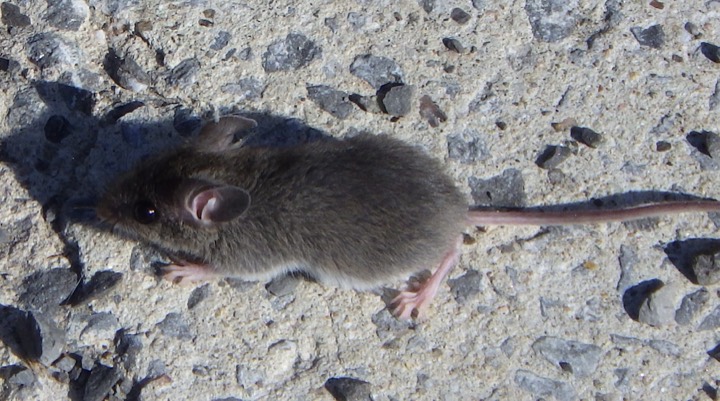

Why you suddenly have mice (and why it is almost always fall)
Mice move indoors when the nights get cold, which in Toronto means September through December. A house mouse needs a gap the width of a pencil, about 6 millimetres, to get inside, and older Toronto housing stock has plenty: the gap where the gas line enters, a worn garage door sweep, the weep holes in brick, a soffit corner. One warm wall and a food source and they stay through winter, breeding the whole time. A single female can produce five to ten litters a year. That is why "I only saw one" turns into a real problem fast, and why the fall call is the cheapest call.
A mouse problem is an entry problem. Kill the mice without sealing the gaps and you have bought yourself a monthly subscription, not a solution.
The signs it is mice, not something else
- Droppings the size of a grain of rice, dark and pointed, usually along walls, in the back of cupboards, or under the kitchen sink.
- Scratching or scurrying inside walls and ceilings, loudest at night when the house is quiet.
- A musky, ammonia smell in an enclosed space like a pantry or a closet.
- Gnaw marks on food packaging, baseboards, or wiring, and small piles of shredded paper or insulation where they nest.
- A greasy smudge along a baseboard or entry hole, from the oil in their fur on the same path run night after night.
Mouse droppings are small and pointed; rat droppings are three times the size and blunt. If the droppings are big, read the rat control page instead, because the plan is different.
How we actually clear them
- Inspection (free). We find the runs, the nest areas, and every entry point, inside and out. This is the step that decides whether they come back.
- Trapping and treatment. We place traps and, where appropriate, tamper-resistant bait stations that keep the product away from pets and children. Health Canada's rules require rodenticide near homes to be used in these locked stations, and we follow them. See the PMRA guidance on rodenticide safety.
- Exclusion, the part that lasts. We seal the entry points with steel wool, hardware cloth, and sealant that a mouse cannot chew through. This is what turns a treatment into a fix.
- Follow-up. We come back to clear traps, confirm the activity has stopped, and check the seals held.
Who can seal your house from mice?
A pest control company that does exclusion work is who seals a house from mice, and it should be the same company doing the trapping. A handyman can caulk a gap, but finding every entry point takes knowing where mice actually get in: where the gas line and cable enter, the weep holes in the brick, the bottom corners of the garage door, the soffit returns, and the sill plate in the basement. Sealing is part of every mouse job we do, not an extra.
We seal with steel wool packed under sealant, quarter-inch hardware cloth, and door sweeps, because a mouse chews straight through foam and plain caulk. If you have no mice yet and want the house sealed before fall, book the free inspection; the price depends on how many gaps there are.
What mouse control costs in Toronto
A standard Toronto mouse job runs $200 to $500. The range depends on three things: how many entry points need sealing, whether the mice have reached the attic or just the main floor, and the size of the home. A one-bedroom condo with a single entry is at the low end. A two-storey semi in the east end with attic activity and half a dozen gaps is at the high end, because the sealing is real work.
| Job | Typical Toronto range |
|---|---|
| Condo / single unit, limited sealing | $200 to $300 |
| House, standard trapping + entry sealing | $300 to $450 |
| Larger home / attic activity / extensive exclusion | $450 to $600+ |
| Follow-up visit (included in most jobs) | usually no extra charge |
Waiting costs money here. A handful of mice in October is a $250 job; an established colony in the walls and attic by February is a $600 one. The full cost page breaks down every pest.
Do you need a pro, or can you do it yourself?
One mouse caught in a trap, with no droppings and no scratching, is often a one-off you can handle with a few snap traps and a tube of sealant. Call a pro when you are seeing droppings in more than one room, hearing activity in the walls, or catching mice faster than you can reset traps. That means they are breeding inside, and store-bought traps alone will not out-pace them. Our honest do-I-need-an-exterminator guide walks through the line.
Do not use poison bait in an open dish if you have pets or young children. Health Canada requires rodenticides around homes to be in tamper-resistant stations for exactly this reason. If a mouse dies in a wall it can smell for a week, which is another reason trapping plus sealing beats bait-and-hope.
Snap, humane, or sticky: which mouse traps work?
Snap traps are the most reliable mouse trap for a Toronto home: they kill quickly, cost a few dollars, and you know exactly when one has worked. Set them along the walls where you find droppings, at right angles to the baseboard, baited with a small dab of peanut butter.
Humane live-catch traps work too, but they leave you holding a live mouse. Release it near the house and it can find its way back through the same gap, especially in the fall when it is looking for warmth. Glue traps are the ones we steer people away from. The mouse dies slowly, they catch whatever else walks across them, and a stuck mouse can drag one under the stove.
Whatever trap you pick, it only handles the mice already inside. If you are still catching mice after a week, they are still getting in, and the fix is sealing, not more traps.
Keeping them out for winter
The mouse-proofing that matters: a door sweep on the garage, steel wool packed into the gap where pipes and wires enter, quarter-inch hardware cloth over weep holes and vents, and food kept in glass or hard plastic rather than the cardboard boxes mice chew straight through. Toronto's property standards bylaw actually requires properties to be kept free of rodents, and sealing is how you meet that without poison.
Common questions
How do I get rid of mice permanently in Toronto?
Trap the mice that are inside and seal every entry point they used, then keep food sealed and clutter down. Bait alone does not do it, because it does not close the door they came through. A proper job includes exclusion, which is why ours does.
How long does it take to get rid of mice?
Most homes are clear within one to two weeks: the first visit sets traps and seals entries, the follow-up confirms activity has stopped. A heavy attic infestation can take longer.
Are mice dangerous?
They contaminate food and surfaces with droppings and urine, can carry salmonella and hantavirus, and their gnawing on wiring is a real fire risk. They are a health and safety problem, not just a nuisance.
What attracts mice into a house?
Warmth and food. Cold nights push them to any building with a gap and a crumb. Pet food left out, an unsealed pantry, and clutter to nest in all keep them once they arrive.
Do I need to leave during mouse treatment?
No. Trapping and sealing do not require you to leave. If we use any product, we tell you about any area to stay off and for how long, per the label.
Is one mouse an infestation?
Not necessarily, but mice rarely travel solo in winter. One caught with no other signs may be a stray. Droppings in more than one spot, or scratching in the walls, means more than one.
Does the guarantee cover mice?
Yes. If mice are still active within two months of the treatment, we come back once at no charge.
What are the first signs of mice?
The first signs are usually dark rice-sized droppings along walls or in drawers and scratching in the walls or ceiling at night. Greasy rub marks along baseboards, gnaw marks, and a musky ammonia smell follow. Droppings in more than one room mean they are breeding inside, not just passing through.
Are humane mouse traps a good idea?
They catch mice without killing them, but a mouse released near the house can find its way back in through the same gap, especially in the fall. If you use them, check them every day, release the mouse well away from the house, and seal the entry point, because the trap does nothing about how it got in.
Can you seal my house from mice before they get in?
Yes. The free inspection finds the gaps a mouse can use, and we seal them with steel wool, hardware cloth, sealant, and door sweeps. Late summer, before mice push indoors in September, is the best time to do it. The price depends on how many entry points need sealing.
Reviewed October 2026.
Prefer to talk? Call
(365) 217-5987Tell us the pest and your neighbourhood and we give you a price range on the spot. The inspection is free, and there is no charge to ask.
- Published price ranges, no "call for a quote"
- Free inspection, price locked before we start
- Licensed and insured technicians
- Two-month guarantee, one free re-treatment
- Honest advice if you do not need a pro yet
Toronto & the GTA · Same-day, 24/7 for emergencies
Get a straight quote
Tell us what you are seeing and we come back with a price range and a time. No obligation, no on-site surprise.