Earwigs are an outdoor moisture pest that wanders indoors, not a household bug that breeds in your walls, so the fix is almost entirely outside: dry out the ground against the foundation and put a barrier where they cross in. They live in damp mulch, leaf litter, garden beds, and the gap along a wet foundation, then push inside through door sweeps, basement windows, and foundation cracks when the weather turns. Toronto sees the classic surge in July and August, and a treatment that only sprays baseboards indoors does nothing about the hundred earwigs still in the mulch bed. Our exterior perimeter work comes with a free inspection, same-day service, and a two-month guarantee.
Why you suddenly have earwigs in the house
Earwigs come inside chasing moisture or fleeing it, and both happen in a Toronto summer. During a hot dry stretch the ground dries out and they migrate toward the damp of a basement or a shaded foundation. After a heavy rain the reverse happens: their harbourage floods and they move up and out, often straight up a foundation wall and in through the first gap they find. You will see them in the bathroom, around the laundry sink, in a basement bedroom, or trapped in a bathtub because they climbed in for water and could not climb out.
An earwig indoors is a wanderer from a colony living in the damp ground outside your wall. The colony is the problem, and the colony is outdoors. This is why the honest fix is perimeter and moisture, not fogging the inside of the house.
Older Toronto neighbourhoods produce the most earwigs. The Beaches, Leaside, the east-end semis, and any ravine-backing or heavily treed lot combine a mature canopy, deep leaf litter, and humid shaded soil right against the foundation. That is earwig habitat pressed up against the house, and July is when the population peaks.
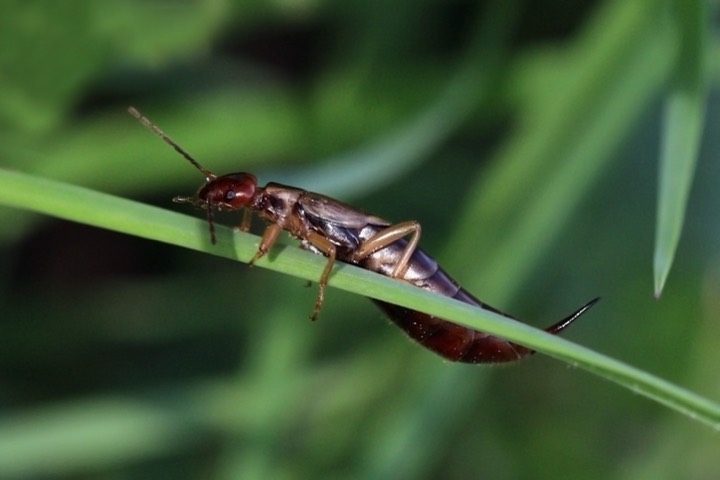

What earwigs actually are (and the myth to drop)
Earwigs do not crawl into your ears and lay eggs. That is an old folk myth with no basis. Earwigs have no interest in ears, do not nest in people, and the name is a leftover from centuries-old superstition. You can stop worrying about that part entirely.
The pincers on the back end, called cerci, look alarming and do nothing meaningful to a person. A large earwig might manage a faint pinch if you trap one in your hand, and it will not break skin or hurt. They do not sting, they are not venomous, and they do not carry disease into the home the way rodents or cockroaches do.
Where earwigs earn their bad name is the garden. They chew ragged holes in leaves, flowers, and soft fruit, and they can shear off seedlings overnight, which is a real headache if you grow vegetables or tend the flower beds those east-end lots are known for. Indoors they are a nuisance, not a hazard.
How the fix actually works: moisture and the perimeter
The real fix for earwigs is drying out the ground against your foundation and treating the band where they cross in, and most of that work is outside the house. Indoor spraying alone does not solve an earwig problem, because it never touches the population living in the mulch. Here is the order that works.
- Pull moisture and harbourage back from the wall. Rake mulch and leaf litter at least 15 to 30 cm off the foundation, clear damp debris, and lift anything sitting flat on wet soil against the house (boards, bags, pots). Earwigs need a dark damp hiding spot by day, and taking it away drives the population down before anyone sprays anything.
- Fix the water. Redirect downspouts away from the wall, clear the grade so rain runs off instead of pooling, and fix any leak or dripping tap that keeps a patch of soil wet. Dry ground is the single biggest deterrent.
- Seal the entry points. Fit or replace worn door sweeps, close foundation cracks, and screen or seal basement windows and vents where they climb in. This is the same entry-point work that keeps out spiders and ants.
- Targeted exterior perimeter treatment. We apply a Health Canada PMRA-registered product in a band along the foundation and the harbourage zones, so the earwigs crossing toward the house hit the barrier outside rather than inside your basement.
If a pest company wants to fog the inside of your house for earwigs and says nothing about the mulch, the drainage, or the door sweeps, they are treating the symptom and billing you for the wrong room.
How Insectica treats earwigs
We start with a free inspection to find where the earwigs are living and getting in, walking the foundation, the garden beds, the downspouts, and the basement entry points. Then we treat the exterior perimeter with a PMRA-registered product, do the harbourage and entry-point work at the wall, and tell you plainly which moisture sources you can remove yourself. We do not upsell an indoor chemical treatment you do not need.
The service is same-day where we can reach you, typically within about 45 minutes, and it carries our two-month guarantee: if earwigs are still crossing in within two months, we come back once at no charge. The work is carried out by Insectica Pest Control, owner-operated out of a Scarborough storefront, BBB A-accredited, a CFIB member, and licensed and insured.
Earwigs are the pest where the honest answer is mostly a rake, a downspout, and a door sweep, plus one exterior barrier to hold the line. We will tell you that to your face.
Earwigs share the same entry story as two pests we treat constantly, so if you are seeing more than one kind, it is often the same gaps. See our spider control page and ant control page, both perimeter-and-entry jobs like this one. For what any of this runs, the full cost breakdown covers every pest.
Common questions
Are earwigs dangerous?
No. Earwigs do not sting, are not venomous, and carry no disease into the home. The pincers on the tail cannot meaningfully hurt a person. They are a nuisance indoors and a plant pest in the garden, nothing more.
Do earwigs really go in your ears?
No. Earwigs crawling into ears to lay eggs is a folk myth with no basis. They have no interest in ears and do not nest in people. The name is an old superstition, not a behaviour.
Why do I suddenly have earwigs in my house?
They are chasing moisture. In a hot dry spell they move toward the damp of a basement, and after heavy rain they flee flooded ground and climb up the foundation and in. They come through door sweeps, basement windows, and foundation cracks, and they are wandering in from a colony living in the damp soil outside.
How do I keep earwigs out?
Dry out the ground against the house and close the gaps. Pull mulch and leaf litter back from the foundation, redirect downspouts, fix leaks, and seal door sweeps, basement windows, and foundation cracks. An exterior perimeter treatment holds the line once the moisture and entry points are handled.
Do I need a professional or can I DIY earwigs?
A handful of earwigs after a storm you can handle yourself by drying out the perimeter and sealing gaps. Call a pro when they keep coming back through summer or you are finding them in numbers indoors, because that means a large outdoor colony is pressed against the foundation and needs a targeted exterior barrier plus the harbourage work.
Why are there so many earwigs in summer?
Earwig numbers peak in July and August. They breed in spring, the young mature by mid-summer, and Toronto's summer humidity plus damp shaded soil in treed older neighbourhoods gives them ideal conditions. Hot dry stretches and heavy rains both push that peak population toward the house.
Reviewed August 2026.
Prefer to talk? Call
(365) 217-5987Tell us the pest and your neighbourhood and we give you a price range on the spot. The inspection is free, and there is no charge to ask.
- Published price ranges, no "call for a quote"
- Free inspection, price locked before we start
- Licensed and insured technicians
- Two-month guarantee, one free re-treatment
- Honest advice if you do not need a pro yet
Toronto & the GTA · Same-day, 24/7 for emergencies
Get a straight quote
Tell us what you are seeing and we come back with a price range and a time. No obligation, no on-site surprise.